Blog
Posted on November 10, 2017
The following email was written to Global Washington’s president & board chair, Akhtar Badshah, by Tazin Shadid, CEO of Spreeha Bangladesh Foundation, on November 6, 2017. Spreeha and Extend the Day, both GlobalWA members, have been working in makeshift camps that were set up for Rohingya refugees in Bangladesh. The correspondence is reprinted here with permission in the hope that it will inspire greater awareness, support, and collaboration towards alleviating suffering in this crisis. If you would like to get involved, please contact info@spreehabd.org.
Dear Akhtar,
Hope you are doing well. I wanted to share with you my experience at the Rohingya refugees. Last weekend Spreeha organized a health camp at the refugee camps in Bangladesh. We were accompanied by one of our partner organizations from Seattle, Extend the Day, and they distributed solar lights to families. I’ve been reading about the Rohingya refugee crisis from the very beginning and following some sources that are sharing pictures and videos on a regular basis. Yet, going over there in person was a whole different experience. I do not have the right words to describe how bad the situation is. I’ve been working in slums with extreme poverty for over ten years now and I have never seen anything like this. Almost a million refugees has now arrived at the camps and the magnitude of the problem cannot be imagined without being there physically.
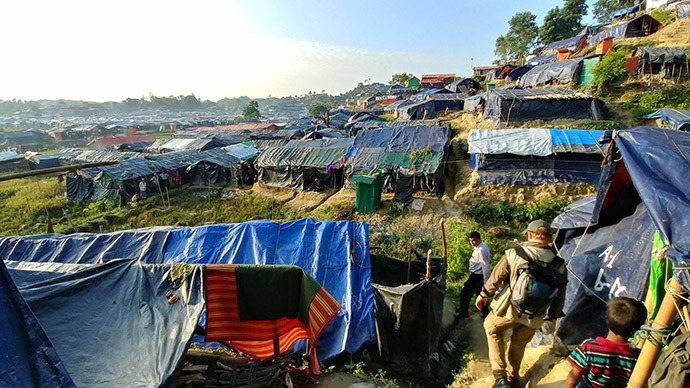
We went to one of the remote camps, Putibonia in Ungciprong, which is past the two big camps Kutupalong and Balukhali, which are more established. One of our partners had received government and military approval to work over there and they are the ones who helped us organize the health camp and the solar lights distribution. As our van was travelling through the roads, we saw thousands and thousands of small shacks just like the slums we work in, but only worse. Each small shack is housing 10-16 people. There’s very little food (only rice sometime) and water. Sanitation issues are huge. We saw kids about 4-5 years old carrying two 5 liter water jars for about a mile and then going on top of the hill.
Continue Reading
Posted on November 7, 2017
By Elsa Watland

On November 2nd, Global Washington and the World Affairs Council partnered to host a panel discussion on Financing Sustainable Agriculture. The panelists represented a range of stakeholders involved in various aspects of agriculture financing. Panelists included Matthew Arnold, managing director and global head of sustainable finance at JPMorgan Chase (JPMC); Steve Hollingworth, president & CEO of the Grameen Foundation; and Paul Moseley, who leads agriculture finance strategy for the Bill & Melinda Gates Foundation (BMFG). The conversation was moderated by Kristen Dailey, executive director of Global Washington.
The future of global food security is a significant challenge humankind will face in the coming years, and smallholder farmers hold the key to this challenge. 2.2 billion people depend on agriculture for their livelihood and 80 percent of the world’s poor are smallholder farmers. By 2050, food production must double to feed the projected global population of 9.8 billion. This means that we must focus on finding sustainable, long-term solutions to ensure agricultural systems are more efficient, and can meet our planet’s rising nutritional needs in three decades.
Continue Reading
Posted on October 13, 2017
© Rozarii Lynch
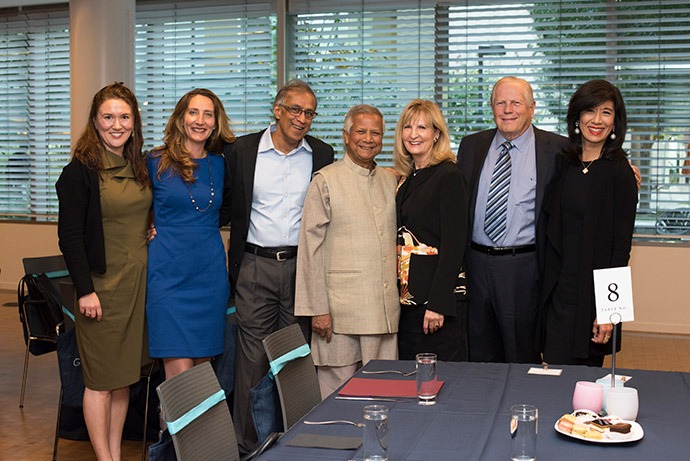
On Wednesday, October 11, together with Seattle Foundation and the Bill & Melinda Gates Foundation, Global Washington honored global philanthropists at a dinner with Bill and Paula Clapp, and the Clapps’ longtime friend and mentor, Nobel Laureate and founder of the Grameen Bank, Muhammad Yunus.
In his talk Professor Yunus shared his philosophy on charity, his views on the nature of poverty, and his new book, A World of Three Zeros: The New Economics of Zero Poverty, Zero Unemployment, and Zero Net Carbon Emissions.
David Wertheimer, director of community and civic engagement at the Bill & Melinda Gates Foundation, welcomed the assembled philanthropists and other distinguished guests. Afterwards, Tony Mestres, President & CEO of Seattle Foundation, gave remarks about the importance of global giving to Seattle Foundation, including observing that in a recent report from Council on Foundations, the Seattle region ranked number two among its community foundation peers across the nation in terms of percentage of total international giving. “I think we should all aim for number one,” he said, drawing a round of applause.
Continue Reading